
Recomposing intellectual work
What decision-making becomes when two kinds of intelligence share the work


TL;DR: We have entered an era with two kinds of intelligence available to perform intellectual work. Generative AI's strength is synthesis: compressing large volumes and expanding the options under consideration. Our human strength is judgement: deciding what matters, what is relevant, to whom, and owning the consequences. Judgement is not reasoning alone. It rests on a felt sense of the impact when making a choice. Recomposing intellectual work means placing each step with the intelligence best suited to it to achieve what would not be possible with either intelligence alone.
Bringing generative AI into a decision-making process is often described as automating it. But automation focuses attention on substitution, existing work done faster or more cheaply, and it only fits decisions whose context is stable enough to be captured fully and applied consistently. Most decisions that carry real consequences are not like that. They are messy and situated, sensitive to conditions and preferences that can change from one case to the next.
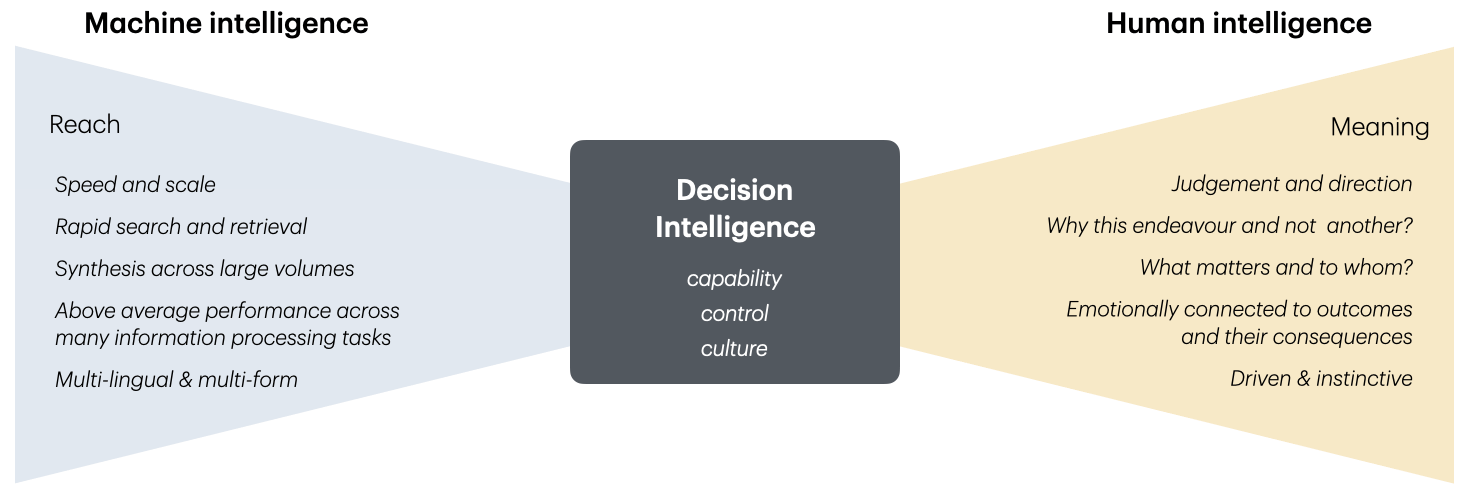
What is new is that we can now bring two kinds of intelligence to these decisions (figure 1). The opportunity is to expand the intellectual capacity we apply to questions needing answers, combining the reach of a machine with human judgement.
Reach as synthesis, not automation
What generative AI is good at is synthesis. It can compress large volumes of material into something usable, draw connections across more sources than a person could hold at once, expand the range of options under consideration, produce a first version of almost anything, and move between many forms and languages. This is its reach: breadth and speed across more information than any person can manage, and above-average performance on a wide span of language-based tasks.
That reach comes with a flaw. The same system that synthesises brilliantly in one step can be confidently wrong in the next with no signal that anything has changed.12 The errors are sparse but they compound across a chain of steps. The reach is real and worth having, but it is not the kind of reliability that can be fully automated. It produces strong candidates, not settled answers.
Meaning as judgement and direction
What generative AI lacks is meaning. Only a human can bring a sense of what the work is actually for. Why this endeavour and not another? What matters within it, and to whom? What is relevant and what can be ignored? Furthermore, to be human is to have a connection to the outcome and its consequences in the lived world.
It is tempting to treat this as a higher grade of reasoning, a part of the work that is simply harder to compute. But judgement rests on something reasoning alone cannot supply, and the clearest evidence is what happens when that something is removed.
In Descartes' Error, neuroscientist Antonio Damasio describes a patient he calls Elliot3. Surgery to remove a brain tumour damaged a region of Elliot’s prefrontal cortex, the area of the brain involved in emotion. His intellect was untouched. His IQ stayed in the top percentiles and his memory, language and reasoning all worked. By every standard test he was unimpaired. Yet his judgement collapsed. He made ruinous financial decisions, lost his work and his marriage, and recounted all of it without distress, as if he were an uninvolved spectator. Asked to settle on one of two dates for an appointment, he could never arrive at a choice. Elliot could still reason. What he had lost was the emotional connection that lets us settle on a preferred answer.
Damasio proposed the somatic marker hypothesis, that judgement depends on the emotional valuation a person brings to a situation, the sense that one outcome is worth more than another in the here and now. A machine can rank options against a measure you provide. It cannot supply the measure. And it holds no stake in the result or concern for consequences. The person carries that stake and can be called to account for the outcome. The machine carries neither.
Placing the intelligence
Each form of intelligence brings different strengths and weaknesses. Machine intelligence has reach over a vast range of content and options but lacks judgement or a sense of what matters in the moment. Human intelligence has judgement but lacks reach, meaning some options that ought to be considered before reaching a conclusion are ignored or missed.
The opportunity is to recompose intellectual work to bring together these two profiles. It begins by laying a process out end to end and going through it step by step, asking of each one which intelligence it needs. Some steps will be synthesis: gathering, analysing, compressing, drafting. Those suit the machine's reach. Some steps are judgement: deciding what the work is for, what matters, what to do when the situation is ambiguous and the stakes are real. Those stay with a person. And some steps are neither, the deterministic work classical automation already does.
Jack Richardson (no relation) is also exploring this field and produced a clear visual (figure 2) to emphasise this placement4.

The two intelligences are at their most valuable when one feeds the other. The machine's synthesis is not an end in itself. It is what lets human judgement range further than it otherwise could. A person who no longer has to assemble the material by hand can weigh more of it. An option set the machine has widened gives judgement more to choose between. This is how we elevate intellectual work in real-world decisions that carry consequences for lives and livelihoods. Judgement applied with more consideration than a person could ever have reached alone.
There is more to placement than capability. The two intelligences do not meet in the abstract. They meet inside an organisation, around a particular decision, and two factors shape how they combine. One is control: where authority over the decision sits. The other is culture, which drives behaviour, and behaviour decides where the machine actually gets used and where people quietly work around it, whatever the design intended. Capability determines what can be done. Control and culture decide what should be done, and what happens in practice.
Designing intellectual processes
To be able to recompose intellectual work requires decision and organisational foundations to support human and machine intelligence (figure 3).
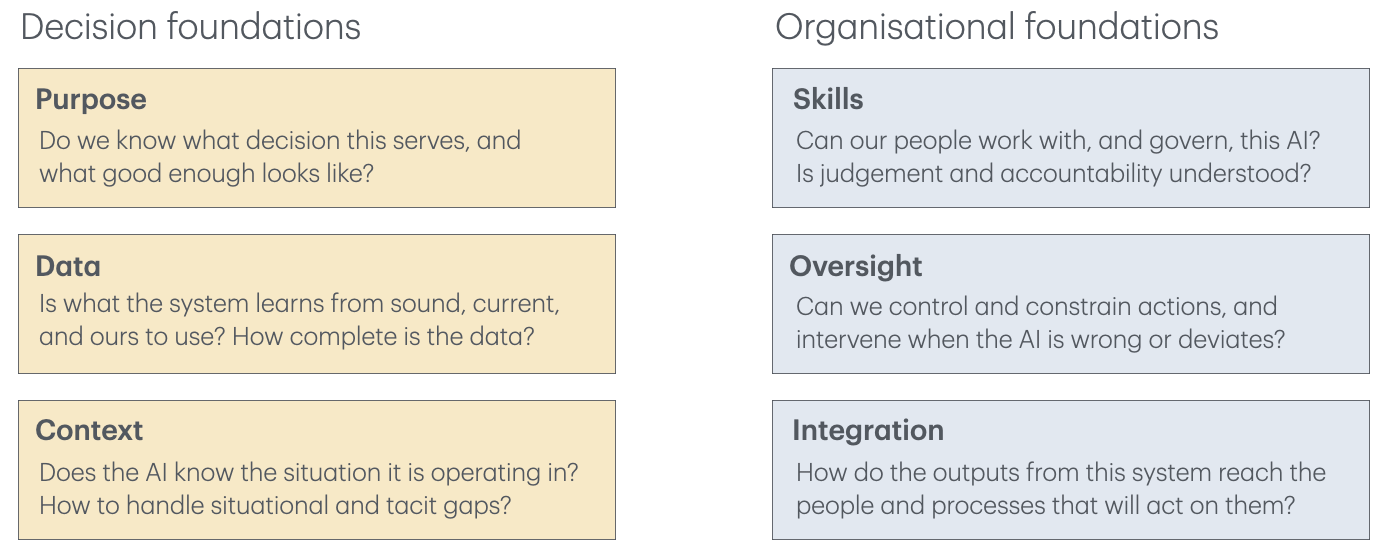
There are foundations needed for the decision itself. Do you know what purpose the work actually serves, and what good enough looks like, before you build anything? Is the data the system learns from sound, current, and yours to use, and complete enough to rely on? Does the system have the context it needs given the situation it is operating in, including the parts that were never written down? That last one is the hardest, because the knowledge that matters most in skilled work is often unrecorded, and a system that never sees it will produce convincing but flawed answers.
The other foundations are about the organisation around the decision. Can people work with the system and govern it, which means the skill to direct it and, more importantly, to judge what it produces? Can you oversee and constrain what it does, and step in when it is wrong? Does any of it connect to the processes that act on the output, so that a good decision becomes a real one? And if yes, how?
These foundations enable you to pressure-test where to place machine intelligence. For each step you intend to hand to a generative model, the honest questions are whether it can do that step well enough and how you would know, whether the data and the context are actually there, whether you have the skill to judge the result, and what your tolerance is for failure. Where those cannot be answered, the step is not ready, however capable the model looks in a demonstration.
Recomposing intellectual work is about scaling our intelligence to do what could not be done before. It is about what becomes possible when synthesis carries the reach and human judgement is freed to range further than previously imaginable.
Related reading
And recommend heading across to Jack Richardson’s post on Automate the parts. Help people navigate the whole, for another perspective on this topic.
References
Damasio, A. (1994). Descartes’ Error: Emotion, Reason, and the Human Brain. Putnam.