
Scaling our intelligence
Rethinking intellectual work in this era of generative AI


TL;DR: We are entering an era where intellectual work can be performed by two intelligences - human and machine-generated. As well as imagining what becomes possible, it requires a fundamental rethink of how such work is organised. Using generative AI to simply replace what humans already do may produce efficiency gains but progress and growth come from innovation not imitation.
What are you optimising for?
It is the first question to ask: what does generative AI bring to a piece of intellectual work? Is it efficiency gains or to create something new? (Table 1)
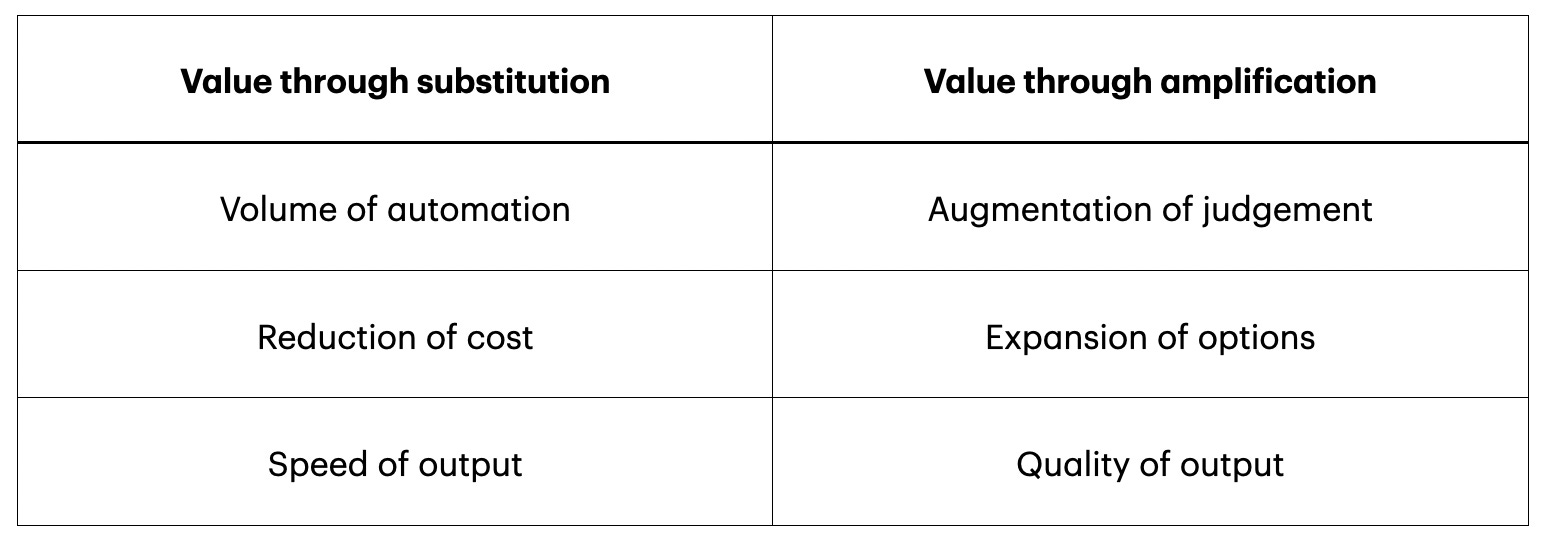
Value through substitution is the pursuit of improving what is already being done. AI is used to optimise an existing process. If it enables tasks to be completed in higher volumes, faster and cheaper then it sets a new performance baseline. In a competitive market, once one organisation pursues this path, all will follow, fail or pivot.
Value through amplification is the pursuit of work that couldn’t be done before, often because it was too complex to undertake within a viable timeframe. AI augments judgement by providing compute power that can expand options for consideration and lead to a higher quality output than was previously possible. It raises the bar.
Substitution treats human intelligence as a cost that can be reduced. Amplification treats human intelligence as an asset that can be expanded. Both create value. The organisation overwhelmed by incoming customer enquiries can likely now automate at least the triage stage to help reduce the backlog and speed up response times. A marketing agency can generate and evaluate far more and richer campaigns.
Leaders at the companies building AI models have predicted sweeping automation of white-collar work, on timelines running from eighteen months to the end of the decade12. That is understandably creating anxiety, particularly among younger people wondering what their career path will look like. But the prediction sees value only in substitution, and that is usually how we get the future wrong. We picture the new technology arriving while everything around it stays the same.

.jpg)
In 1957, Disneyland’s Tomorrowland opened the Monsanto House of the Future. It was moulded almost entirely from plastic and fitted with a microwave oven and an ultrasonic dishwasher, decades before either was ordinary. The home was toured by a “Housewife of Tomorrow”, the domestic arrangement of the 1950s3. Every gadget had been reimagined for the future whilst family roles remained frozen in time.
The same instinct runs through the assumption that AI will simply do the existing jobs, only without the people. The real value from generative AI will come from identifying its strengths and weaknesses relative to human intelligence, and rethinking what becomes possible with two kinds of intelligence at work.
Two kinds of intelligence
Perhaps the excitement with generative AI is because it is the first machine intelligence created that we interact with as if we are talking to a human. Whilst it creates the risk of anthropomorphising the AI, treating it as if it has all the attributes of a human intelligence, that impulse rests on something real.
In Surfing Uncertainty, Andy Clark argues that the brain is itself a kind of prediction machine, constantly running ahead of the moment, guessing what comes next and adjusting when it gets it wrong.4 It is one account of cognition among several, and a contested one, but it captures something we recognise. And in the crudest terms, it is what a large language model does too. You provide a prompt and get a response. You reply, it replies. The rhythm has a familiarity to it.
But the intelligence behind AI-generated answers is built differently (figure 1).
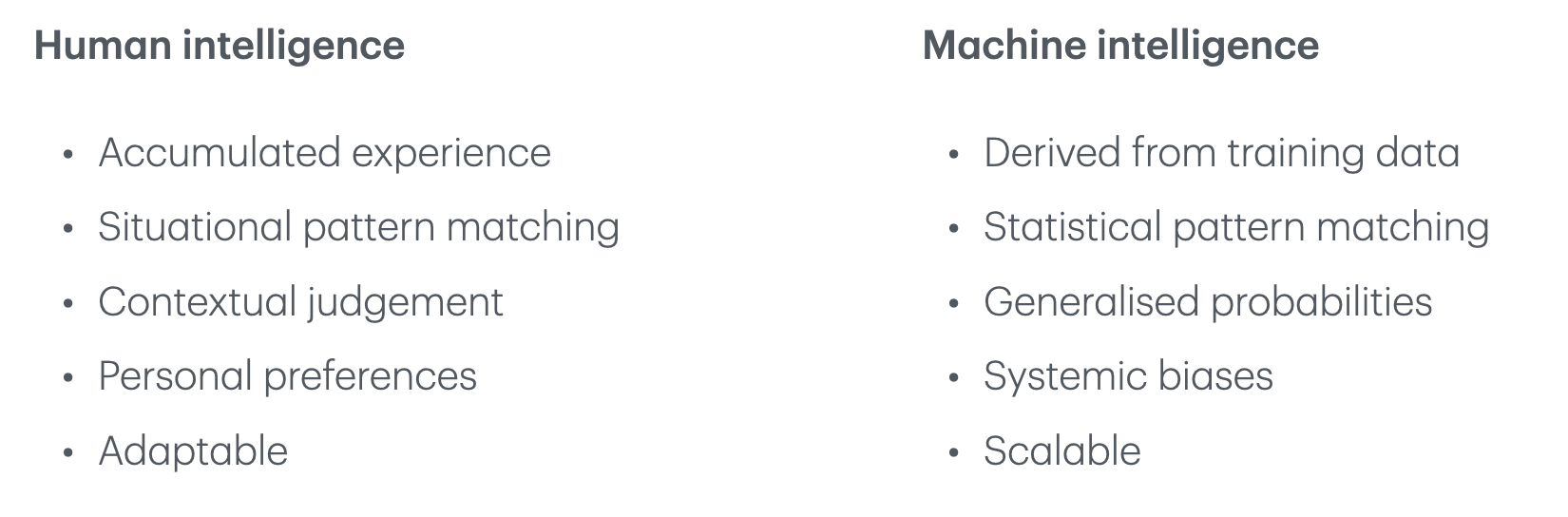
Machine intelligence in the form of large language models is derived from training data. It works by statistical pattern matching across an enormous body of material, which means it operates on generalised probabilities: what usually follows what, across everything it has seen. That gives it remarkable reach. It can search and retrieve at a scale no person can match, work across many domains at once, move between languages and formats, and perform above the human average on a wide range of language-driven tasks. It also inherits the biases and gaps sitting in its training data, which is part of why it can be confidently wrong on one task despite having been fine on a near-identical one, creating a substantial reliability problem56.
Human intelligence comes from accumulated personal experience, mostly lived rather than read. It matches patterns situationally, against the specific circumstances in front of us. It carries contextual judgement, an instinct for what matters here and now and to whom. Responses are shaped by personal preferences and by an emotional stake in the outcome that connects us to the consequences of our choices. And sometimes we get it wrong. We lean on cognitive shortcuts, see what we expect to see, and carry biases we do not notice we hold. The development of our intellect is comparatively slow and does not scale. But it is much more adaptable, and that adaptability combined with imagination drives innovation and progress.
Set the two columns side by side and they read almost as a mirror image. Machine intelligence is fast, broad and tireless. It can take in more than any person could, work across many domains at once, and hold a steadier average than we manage. That is reach. Human intelligence is slower and does not scale, but it grasps what a situation actually is, what matters within it, and who lives with the result. That is meaning. One brings range and pace. The other brings purpose and a stake in getting it right.
Rethinking intellectual work
This is where the choice at the start returns. Substitution begins by breaking work into tasks and asking which ones a machine can take. It is the natural question, and it quietly assumes the work itself stays the same. Rethinking intellectual work means starting with the purpose. What is this work actually for, and what becomes possible if two kinds of intelligence are brought to it rather than one?
That is a harder question than “what can we automate,” and it does not have a tidy answer. Composing intelligence is not the same as handing work over. It means knowing what each kind is good for, leaning on the machine for reach and on the person for what matters and what is at stake, and keeping someone close enough to catch the moments the machine cannot. It raises questions most organisations have not had to ask before. How much do you hand over, and when? How do you keep human judgement in the loop without losing the speed that made the machine worth using? What has to change in how people work, and what they are accountable for, when the work is no longer theirs alone?
These are not questions with simple or single answers. The pull towards substitution is strong, because it is easy to cost and easy to start. The harder path, composing two kinds of intelligence into work that neither could do as well alone, is where the lasting value will be. It begins not with what we can hand over, but with what we can now do.
Related
References
Heikkilä, M (2026). “Mustafa Suleyman plots AI ‘self-sufficiency’ as Microsoft loosens OpenAI ties.” Financial Times, 11 February 2026. Source
Hope, K. & Olcott, E (2025). “AI jobs danger: Sleepwalking into a white-collar bloodbath.” Axios, 28 May 2025. Source
Bossert, D.A. (2023). “The Legacy of Disney’s Monsanto House of the Future.” Dwell, 22 September 2023. Source
Clark, A. (2016). Surfing Uncertainty: Prediction, Action, and the Embodied Mind. Oxford University Press.