
No LLM will achieve general intelligence
If I see one more post about an LLM not knowing how many ‘r's are ‘strawberry’…

If the goal of your prompt is ill-suited for an LLM and your AI assistant has no instruction for using an alternative method or model, you will get an ill-informed response.
Some time ago, somebody found that the large language model (LLM) underpinning the ChatGPT AI assistant - GPT-4 - couldn’t correctly state how many ‘r’s are in the word ‘strawberry’. For some, this was evidence of the absence of I in AI.
Many articles were written to explain why counting characters was a tricky ask of LLMs - here’s one. The recent release of GPT-5 has brought the meme back. GPT-5 is now confident about how many ‘r’s there are in ‘strawberry’ but allegedly* (comment at end of post) can still be tripped up by the number of ‘r’s in ‘rhododendron’…
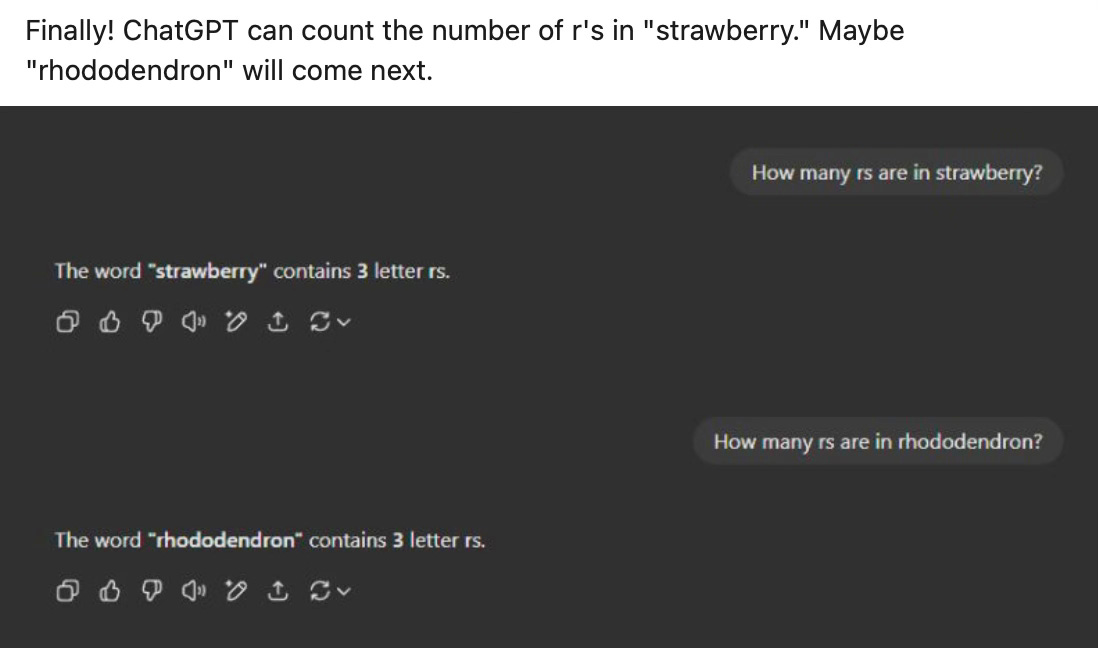
Image source: Joshua S on LinkedIn
The purpose of an LLM is to generate a sequence of human-readable words in response to a human-readable prompt, mimicking human abilities at interpreting, processing and generating written language. This is something traditional computer-generated language models and the field of natural language processing had been struggling with for decades.
The LLM, based on a transformer-based architecture proposed in 2017, has gone beyond initial expectations to also perform tasks it was not explicitly trained for. Such as being able to translate between languages and classifying content into topics. It has proved surprisingly effective at synthesising and summarising content provided as input, and is able to generate novel content using only its training data, such as - ‘describe the process of photosynthesis in the style of Winston Churchill’.
These unexpected capabilities of LLMs helped reignite the topic of artificial general intelligence (AGI): can an AI be created that can mimic all human cognitive abilities?
But there are plenty of tasks that an LLM cannot (currently) do or was not designed for. It is not a calculator, or certainly not an efficient one. And this is perhaps where some of the confusion is created. ChatGPT is an application that uses an LLM to interpret prompts and generate responses. But it also includes other models along with other instructions. Last year, if you asked ChatGPT to create an image, DALL-E, the computer vision model, would be used to generate a visual response. If your prompt is ill-suited for an LLM and ChatGPT has no instruction for using an alternative method, you will get an ill-informed response.
To count the number of ‘r’s in a word, a simple natural language processing function would suffice. For example, in Python:
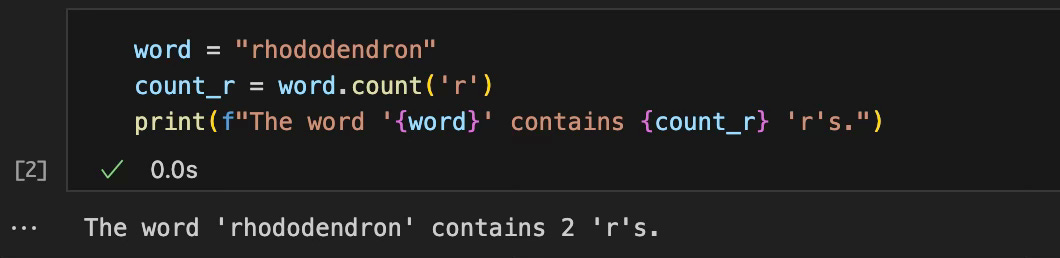
Image: Simple word character matching function in Python
Presumably, at the time, ChatGPT did not have any instructions for handling simpler natural language processing tasks that do not require an LLM.
Ask a human to think about a strawberry or whether or not they like strawberries, and the first reaction for most is likely to be some kind of internal visualisation of a strawberry, perhaps also sensation relating to its taste and texture. Maybe a memory from eating strawberries and cream in the summer, or trying to recall if The Cornetto Trilogy included strawberry flavour…
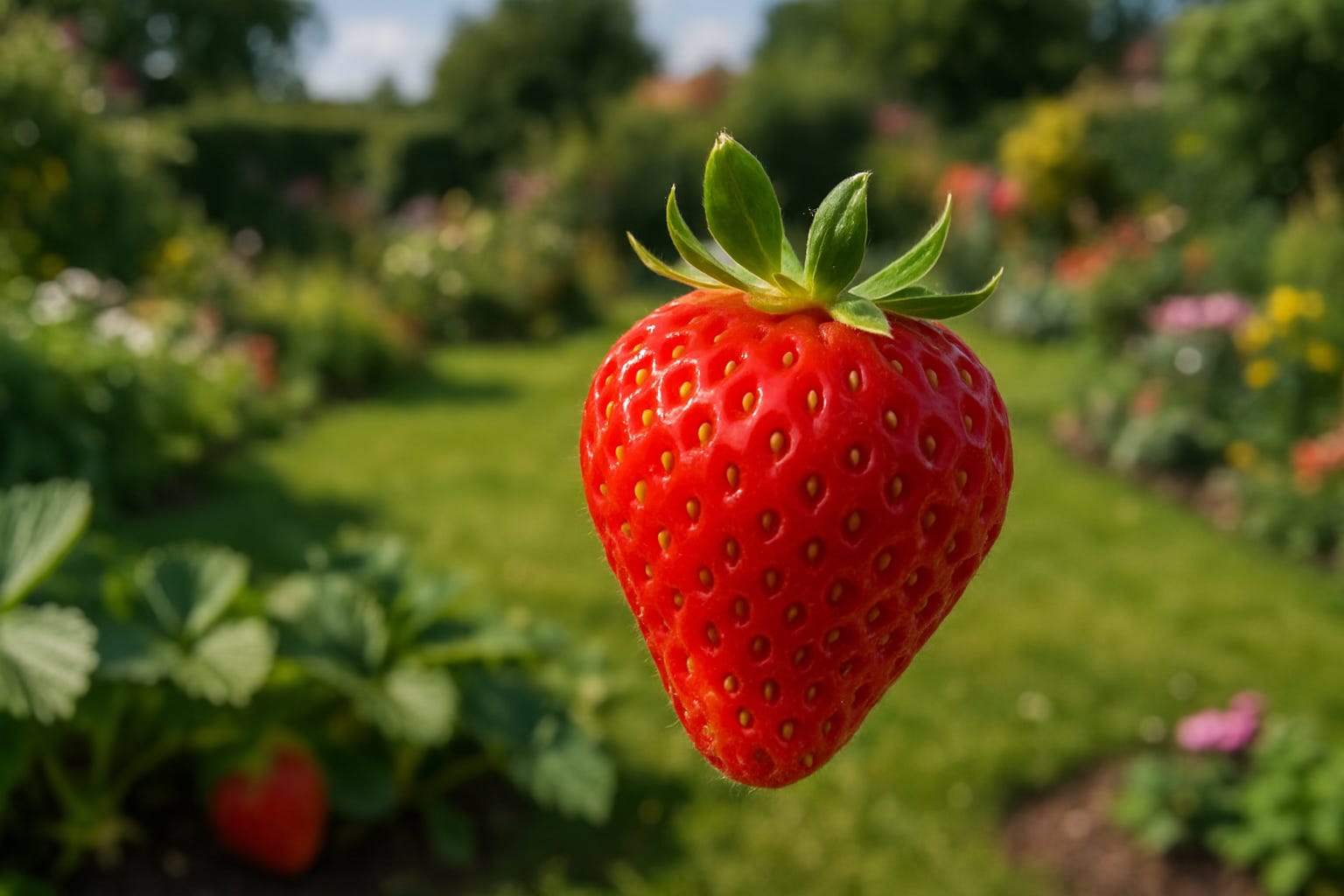
Image: ChatGPT-generated picture of a strawberry
Now ask a person how many ‘r’s are in the word ‘strawberry’ and that vision will likely be replaced with a text representation of the word. Perhaps using a plain font to make it easy to identify the individual letters. It may involve an audio approach, voicing each letter with or without sound, forming its ‘shape’ using your mouth. Some people will use their fingers to count off the ‘r’s as they come across them working along S-T-R-A-W-B-E-R-R-Y.
In short, we humans activate many different models both in our minds and physically, to figure out answers to prompts. No single LLM will ever outperform that process.
The main model underpinning ChatGPT today is called gpt-5. Is it an LLM? GPT stands for the style of training using artificial neural networks with data - Generative Pre-trained Transformer. The Transformer-based architecture underpinned the arrival of LLMs but is now being applied beyond language. OpenAI’s documentation for gpt-5 states that it can take text and images as input but cannot produce images as output. For that, a different model is required - ‘gpt-image-1’ which is replacing DALL-E. So it seems gpt-5 is still an LLM.
Perhaps the confusion is because ‘GPT-5’ as part of ChatGPT really means all current models integrated into ChatGPT, starting with gpt-5 to interpret the incoming prompt. ChatGPT then activates appropriate models to process and generate a response. If you interact directly with gpt-5 and want an image as the response, you will need to separately call gpt-image-1. In ChatGPT, this is all done behind the scenes, along with goodness-knows-what-else to control its behaviour.
Back to our favourite example - counting the ‘r’s in Strawberry, ChatGPT indeed now seems to be demonstrating the use of a simpler processing function to count, literally spelling it out in the response:
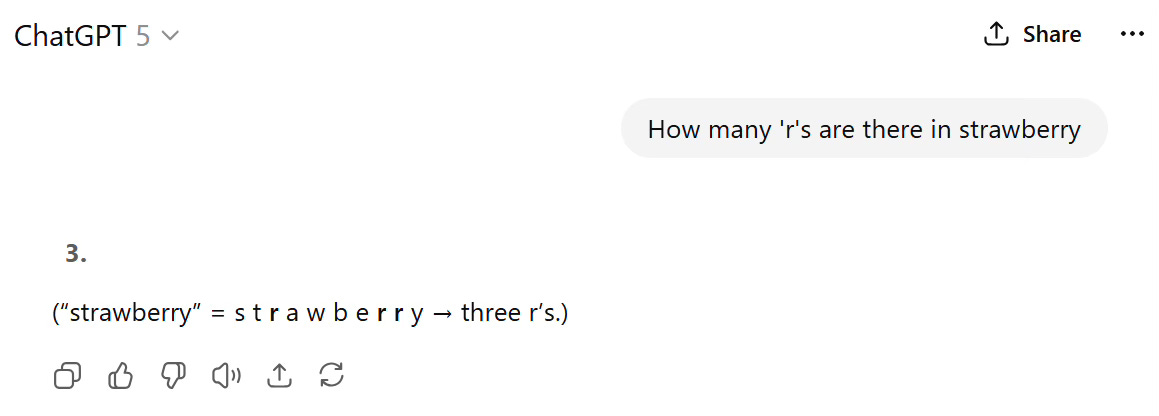
Image: asking ChatGPT 5 the infamous “how many ‘r’s in strawberry” question.
The increasing number of models being integrated into ChatGPT - and, presumably, all other AI assistants - suggests that an LLM alone will never match human-level intelligence at all cognitive tasks. A ‘many models’ approach is needed and already being developed. Whether the Transformer-based architecture will prove universal for all the different models needed to produce AGI is a different (and more interesting) debate...
* Allegedly because I could not reproduce this on ChatGPT with GPT-5 (default). It correctly answered ‘3’ for strawberry and ‘2’ for rhododendron. It also answered ‘2’ when I tried to trip it up with “how many ‘r’s in 'strawbery’?” 🤷♀️
References
Why ChatGPT Can’t Count How Many Rs in Strawberry - 16x Prompt, Sep 2024
Finally! ChatGPT can count the number of r's in "strawberry." Maybe "rhododendron" will come next. - Joshua S, LinkedIn, Aug 2025
Attention is all you need - by Vaswani et al, Proceedings from the 31st Conference on Neural Information Processing Systems (NIPS 2017)
The Cornetto Trilogy - Wikipedia, accessed 21 August 2025 (I never realised they actually do have specific flavours for each movie…)
GPT-5 model - OpenAI documentation, accessed 21 August 2025
Image generation - OpenAI documentation, accessed 21 August 2025
All links active and as represented at time of writing - 21 August 2025.